Understanding subjects with profound cultural, historical, and artistic depth, such as the Moai statues of Rapa Nui, requires a meticulous approach to content creation. For SEO professionals and content strategists, the challenge lies not just in presenting information, but in curating it with accuracy, authority, and comprehensive detail. This ensures the content resonates with an engaged audience seeking genuine insight, establishing the publisher as a credible source. A deep dive into the Moai offers a practical example of how to dissect a complex topic, from its core meanings to its visual identifiers, providing a framework for developing authoritative content that stands apart.
Unpacking the Moai: Core Meanings and Cultural Significance
The Moai statues are not merely stone figures; they are potent symbols embedded in the spiritual and social fabric of Rapa Nui (Easter Island). Their primary function was to embody the ancestral spirits, known as aringa ora or 'living faces,' of deified ancestors and important chiefs. These figures were believed to watch over the community, projecting their benevolent spiritual power, or mana, inland from their coastal platforms (ahu) to protect the villages and ensure prosperity.
Ancestral Reverence and Mana
Each Moai represented a specific ancestor, whose spiritual essence was believed to reside within the statue. This ancestral connection was vital for the Rapa Nui people, linking them directly to their lineage and the spiritual realm. The act of carving and erecting a Moai was a profound ritual, intended to harness and direct the ancestor's mana for the benefit of the clan. The statues were not worshipped as gods, but revered as vessels for powerful ancestral spirits, influencing fertility, harvests, and the general well-being of the community.
Social and Political Statements
Beyond their spiritual role, Moai also served as significant markers of social status and clan identity. The resources required to quarry, carve, and transport these colossal figures were immense, signifying the wealth, power, and organizational capabilities of the clan responsible for their creation. The size and number of Moai on a particular ahu could reflect the prestige and influence of a lineage, contributing to inter-clan competition and a monumental building frenzy that peaked between the 13th and 16th centuries.
The Distinctive Style and Engineering of Moai
The artistic and engineering prowess demonstrated in the creation of the Moai is a testament to the Rapa Nui people's ingenuity. These monolithic human figures share a common stylistic blueprint, yet exhibit subtle variations reflecting different periods and carvers.
Carving Techniques and Quarry Origins
The vast majority of Moai, approximately 95%, were carved from the volcanic tuff found at the Rano Raraku quarry, a volcanic crater on the eastern side of Rapa Nui. Carvers used basalt hand picks (toki) to meticulously shape the figures directly from the rock face. Once detached, the statues were slid down the slopes of the quarry, often leaving them in various stages of completion. The final detailing, including the carving of the eye sockets, was typically performed once the Moai had reached its designated ahu.
Anatomical Features and Variations
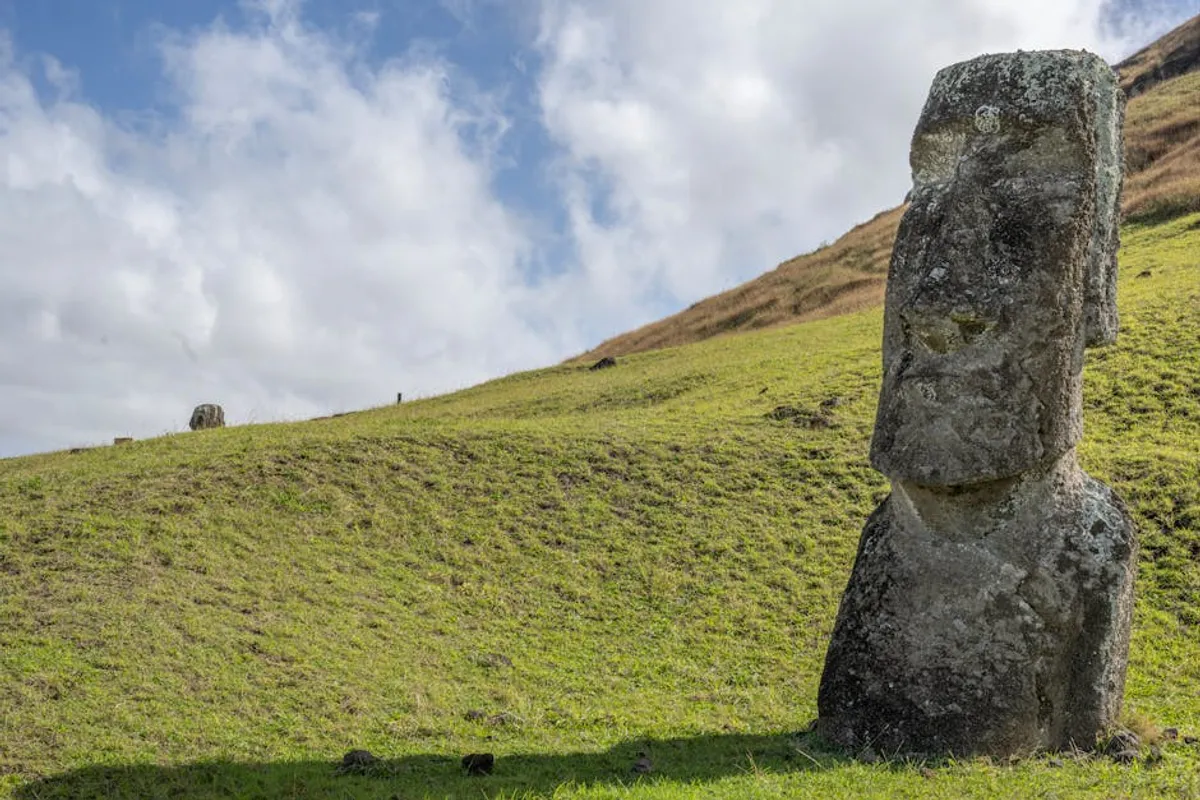
The canonical Moai style is characterized by:
- Elongated heads with prominent brows and deep-set eye sockets.
- Long, straight noses with flared nostrils.
- Thin lips and a stern, unsmiling expression.
- Elongated earlobes, often reaching the shoulders.
- Short, powerful torsos with arms held close to the body, hands resting on the abdomen, sometimes with fingers touching the navel, symbolizing fertility and lineage.
- Absence of legs, as the statues were designed to be partially buried or stand on platforms.
While sharing these core features, some Moai exhibit distinct characteristics, such as different types of headwear (pukao) made from red scoria, or variations in facial expressions and body proportions, indicating stylistic evolution over centuries.
The Ahu and Pukao: Contextual Elements
The ahu are the ceremonial stone platforms upon which the Moai were erected. These platforms varied in size and complexity, often containing burial chambers. The pukao, large cylindrical topknots or hats made of red scoria, were placed on the heads of some Moai, particularly those from later periods. The pukao are thought to represent hair, a traditional topknot, or a ceremonial headdress, further enhancing the statues' imposing presence and signifying additional status.
A Timeline of Moai Creation and Decline
The history of Moai production spans several centuries, reflecting periods of stability, growth, and eventual societal upheaval on Rapa Nui.
Early Period to Peak Production (1000-1600 CE)
The earliest Moai carvings are estimated to date back to around 1000 CE, with production intensifying and reaching its peak between 1200 and 1600 CE. During this time, the Rapa Nui society was organized into distinct clans, each competing to erect the most impressive Moai on their respective ahu. This period saw the creation of the largest and most complex statues, reflecting a flourishing culture with sophisticated organizational structures.
The Ahu Moai Cult and Its Evolution
The "Ahu Moai Cult" refers to the period when the construction and veneration of Moai on ahu platforms were central to Rapa Nui religious and social life. This cult was intertwined with the island's ecological stability. As resources, particularly timber for transport and fuel, became scarcer due to deforestation, the ability to create and erect Moai diminished. This environmental degradation contributed to increasing social tensions and warfare.
Toppling and European Contact
By the late 17th and early 18th centuries, the Moai began to be systematically toppled, likely due to internal conflicts and the collapse of the societal structures that supported their creation and veneration. Oral traditions speak of 'Huri Moai' or 'Moai toppling,' suggesting a period of civil unrest where the symbols of rival clans were deliberately overthrown. When European explorers first arrived in the 18th century, many Moai were already lying face down, a process that continued until the last standing Moai was reportedly toppled in 1868. This period marked a profound shift away from the ancestral Moai cult towards other forms of worship, such as the Birdman cult (Tangata Manu).
A Visual Deconstruction: Key Moai Characteristics
Observing a Moai involves recognizing a distinct set of visual attributes that define its iconic form and convey its cultural weight. These features are consistently present, making them readily identifiable despite individual variations.
When analyzing Moai visually, look for:
- The Head-to-Body Ratio: Disproportionately large heads, often making up about one-third of the statue's total height, emphasizing intellectual and spiritual power.
- Facial Features: Deep eye sockets, originally inlaid with coral and obsidian for eyes, which were added only after the statue was erected on its ahu to "activate" its mana. Prominent, straight noses and thin, downturned mouths suggest solemnity.
- Earlobes: Elongated and often touching the shoulders, a common Polynesian aesthetic signifying status or wisdom.
- Hands and Abdomen: Arms held close to the body, with hands typically meeting over the lower abdomen or navel, a gesture often associated with fertility, lineage, or holding spiritual power.
- Overall Stance: A rigid, upright posture, conveying a sense of watchfulness and steadfastness.
- Pukao Presence: Note the presence or absence of a pukao, as this red scoria topknot signifies a later period of carving and potentially higher status.
Pro Tip: When sourcing visual content for complex historical or cultural subjects, prioritize images from reputable archaeological institutions, national geographic societies, or academic archives. Ensure captions accurately describe the specific Moai, its location (e.g., Rano Raraku quarry, Ahu Tongariki), and any notable features. Misidentified or poorly contextualized visuals can undermine the authority of even well-researched text.
Crafting Authoritative Content on Complex Subjects
Developing content around subjects like the Moai requires more than superficial research. It demands an interdisciplinary approach, integrating archaeology, anthropology, art history, and environmental science to construct a complete narrative. For content creators, this means:
- Deep Dive Research: Moving beyond introductory sources to academic papers, museum collections, and expert interviews.
- Contextualization: Placing the subject within its broader historical, cultural, and ecological environment to explain "why" things happened, not just "what."
- Visual Integration: Using high-quality, accurately captioned visuals that genuinely enhance understanding, rather than serving as mere decoration.
- Nuance and Acknowledgment of Debate: Presenting differing scholarly interpretations where they exist, demonstrating a thorough understanding of the subject's complexities.
Practical Insights for Content Creators
For any content professional, creating a comprehensive resource on a topic as rich as the Moai statues exemplifies the process of building topical authority. This involves a commitment to factual accuracy, a nuanced presentation of historical and cultural context, and a clear, descriptive style that educates and engages the reader. By meticulously detailing the meaning, style, and history, along with a visual guide, content becomes a valuable asset for users seeking in-depth information. Such content not only serves the immediate informational needs of the audience but also establishes the credibility and expertise of the content producer, fostering trust and repeat engagement.
Frequently Asked Questions
What is the purpose of the Moai statues?
Moai statues primarily served as embodiments of deified ancestors (aringa ora), believed to project spiritual power (mana) over the Rapa Nui communities, ensuring protection, fertility, and prosperity. They also functioned as symbols of clan status and power.
How were the Moai statues moved and erected?
The exact methods for moving Moai are still debated, but archaeological evidence and oral traditions suggest they were transported upright or horizontally using ropes, sledges, and rollers made from tree trunks, then "walked" to their ahu platforms. Ramps and levers were likely used for final erection.
Why were the Moai statues toppled?
The systematic toppling of Moai, known as 'Huri Moai,' is generally attributed to internal tribal warfare and societal collapse on Rapa Nui, exacerbated by ecological degradation and resource scarcity. Toppling rival clans' Moai was a way to dismantle their spiritual and social power.
Are all Moai statues the same?
While sharing a distinct canonical style, Moai statues exhibit variations in size, specific facial features, and the presence of pukao (red scoria topknots). These differences can reflect different periods of carving, individual carvers' styles, or the status of the ancestor they represented.