
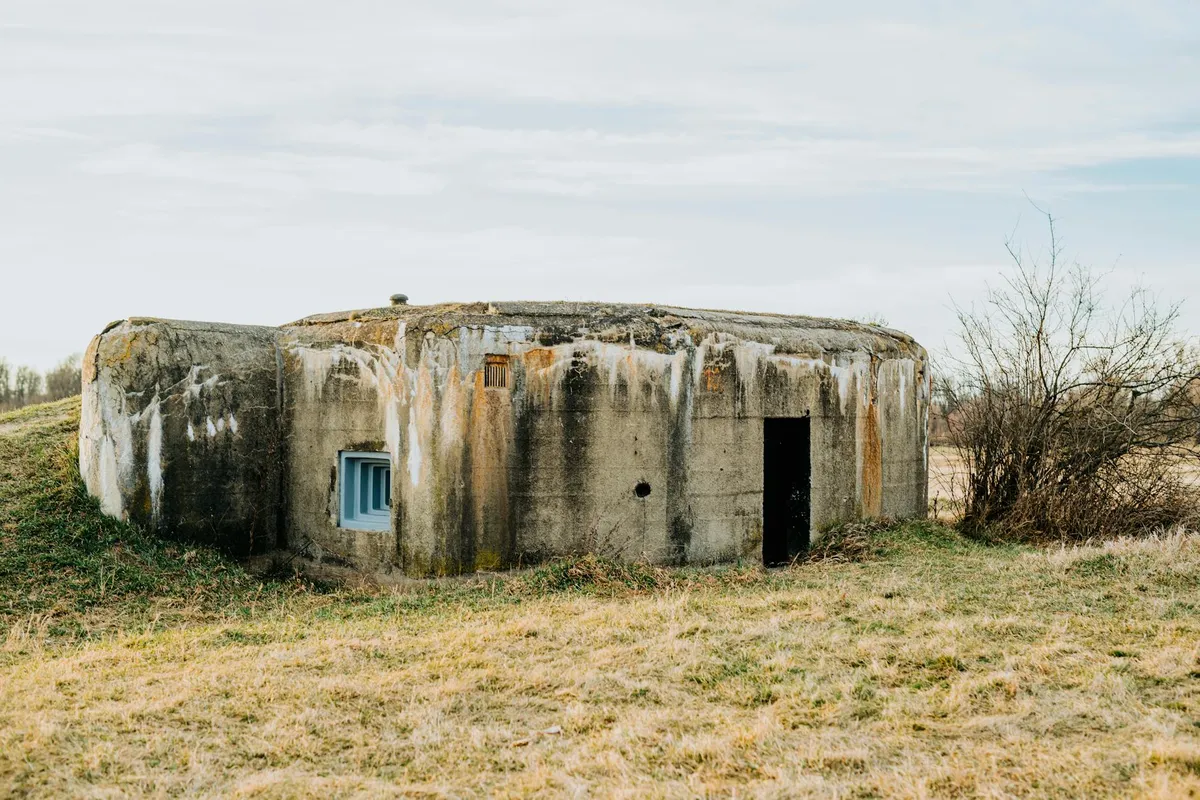
The Taunton Stop Line was constructed across the summer and autumn of 1940 as part of the broader system of defensive positions intended to slow a potential German invasion of southwest England. The line ran from Seaton on the Devon coast, north through the Blackdown Hills, across the Somerset Levels, and terminated near the Bristol Channel coast. Its construction involved thousands of pillboxes, anti-tank obstacles, river demolitions, and various ancillary works.
The line was never tested in combat. The invasion did not come. The defensive position remained in service for some months, was gradually downgraded as the threat receded, and was largely abandoned by the war's end. Most of the moveable elements were removed. The fixed concrete works mostly remained.
I have been walking the line systematically for the past several years, working county-by-county through the surviving structures. Walking the line teaches you specific things that the documentary record alone cannot teach. This essay is about what walking has actually taught me.
The pillboxes are smaller than the documents suggest
The first thing the documentary record gets wrong, or at least conveys imperfectly, is the scale of the structures. Pillbox specifications appear in archive material with their dimensions clearly stated. Reading the dimensions on paper does not prepare you for the actual structures.
The standard infantry pillbox positions a small number of men, typically four to six, in a structure that is genuinely cramped. Standing inside one for the first time, you understand that the conditions for the infantry assigned to these positions would have been wretched. Cold concrete, limited light, restricted lines of sight through narrow embrasures, no real provision for sustained occupation. These were positions designed for short-duration defensive action, not for the prolonged occupation that any actual defensive battle would have required.
The implication for thinking about the defensive plan is that the pillboxes were components of a system that assumed reinforcement and rotation. Individual pillboxes could not have held for long. The system depended on the broader defensive effort that the line was part of, not on the individual structures.
The siting decisions are revealing
The siting of pillboxes along the line shows the planning intelligence that went into the position. Pillboxes are sited to cover specific approaches — bridges, road junctions, fords, lines of advance that the terrain permits. Walking from one pillbox to the next, you see the defensive logic. They are arranged to provide mutual support where possible, to cover the obstacle line they protect, and to dominate the specific tactical features that an attacker would have to cross.
The siting also shows where the planning went wrong or was constrained by considerations beyond pure tactical efficiency. Some pillboxes are sited in positions that would have been difficult to defend in practice — too exposed, with too narrow an arc of fire, or too far from supporting positions. Walking these you understand that the defensive line was constructed under enormous time pressure with imperfect information, and that some of the placement decisions reflect the practical constraints of building a major defensive position in a few months rather than optimal tactical thinking.
The siting decisions also reveal the strategic logic of the line as a whole. The Taunton Stop Line was meant to delay rather than defeat an invasion force. The siting accordingly emphasises terrain features that would slow an attacker — river lines, defile positions, urban approaches — rather than positions that would have allowed sustained engagement.
The construction quality varies in interesting ways
The pillboxes were constructed by a combination of civilian contractors and military engineering units working under time pressure with locally available materials. The construction quality varies as you would expect from such a programme.
Some pillboxes are remarkably well-constructed. The concrete is dense, the embrasure work is neat, the internal fittings show care in execution. These structures have weathered eighty-five years in the British landscape with minimal degradation.
Other pillboxes were constructed less carefully. The concrete is poor quality, the form work was crude, the structures show various signs of construction shortcuts. These have weathered worse over the decades. Some have substantial structural problems. Some have collapsed entirely.
The variation tells you something about how the defensive programme was actually executed at the local level. The standardised plans assumed standardised construction. The actual execution was more uneven. The line as it existed in 1940 included a mix of structurally sound and structurally weak components. The defensive value of the line correspondingly varied along its length.
The landscape has changed around the line
The landscape that the Taunton Stop Line was sited in has changed substantially over eighty-five years. Some of the changes affect what walking the line reveals.
Hedgerows have grown up around pillboxes that were originally positioned for clear lines of sight. Many pillboxes that had clear arcs of fire in 1940 are now embedded in vegetation that limits visibility significantly. The defensive logic that was visible in the original siting requires imaginative reconstruction.
Roads have shifted. Some pillboxes were sited to cover specific road junctions that no longer exist or have moved. The tactical logic that placed the structures is sometimes invisible because the features they were designed to cover have changed.
Land use has shifted. Pillboxes that were sited in open agricultural land are sometimes now embedded in urban or peri-urban development. Walking to them takes you through housing estates rather than through the rural landscape they were designed for.
The cumulative effect is that walking the line requires constant mental reconstruction of what the landscape looked like in 1940. The structures themselves are still there but their context has shifted in ways that affect what you can read from the surviving record.
The local memory has thinned
The local memory of the line's construction and operation has thinned substantially over the decades. The people who lived through the construction and who remember the structures being built are nearly all gone. The local stories about specific pillboxes — who built them, what units occupied them, what local incidents involved them — are largely lost or survive only in the most fragmentary form.
Walking the line and talking to local residents, you encounter occasional fragments of memory passed down through families. A specific pillbox that a grandfather worked on. A construction camp that occupied a specific field. The visit of a senior officer to a specific position. The fragments are valuable when you can collect them but they are decreasingly available.
The implication for the next phase of fieldwork on the line is that the documentary archive and the structures themselves are the primary sources available. The oral history component that was substantial twenty years ago is essentially closed now. What we have in archives and in the structures is what we have.
The condition trajectory is mixed
The condition of the surviving structures across the line is mixed and the trajectory is not uniformly toward loss.
Some structures have been actively preserved by interested local groups. Pillboxes that have been adopted by local heritage organisations have generally been stabilised, protected from vegetation overgrowth, and provided with interpretive signage. These are in better condition than they were a decade ago and are likely to survive long into the future.
Other structures continue to deteriorate without intervention. The natural processes of vegetation overgrowth, frost weathering, soil movement, and ordinary structural fatigue continue to reduce the surviving record. Some structures that were intact when I started fieldwork are now significantly damaged.
A small number of structures have been actively destroyed during the period of my fieldwork. Modern development pressure, agricultural improvement, and various other land use changes have removed pillboxes that had survived for eight decades only to be lost in the past few years.
The aggregate trajectory across the surviving structures is gradually downward but with substantial variation by location. The structures that survive longest will be those that benefit from active preservation. The ones without preservation attention are gradually being lost.
What the line still teaches
Despite the changes and the losses, the surviving structures of the Taunton Stop Line still teach things that documentary sources alone do not teach.
They teach the scale of the 1940 defensive effort in physical terms that document descriptions cannot quite convey. Walking from one pillbox to the next across the line gives you a visceral sense of the construction undertaking that the archival records describe more abstractly.
They teach the human conditions of the defensive positions. The structures themselves communicate what occupation would have been like in ways that no document can match.
They teach the planning intelligence and its limitations. The siting decisions and the construction quality both visible in the surviving structures reveal what the planners got right and where the constraints of the time produced compromises.
They teach the relationship between military planning and the landscape. The interaction between the defensive logic and the specific features of Somerset is visible in ways that abstract descriptions cannot capture.
These lessons are available only through fieldwork. The archive describes the line. The fieldwork lets you understand it.
What the work continues to require
The fieldwork on the Taunton Stop Line and similar defensive positions continues to require sustained attention. The structures are not getting younger. The landscape continues to change. The local memory continues to thin. The documentary archive remains finite and is not gaining new material.
The work that remains worth doing includes systematic documentation of structures that have not been adequately surveyed, condition monitoring of structures that are at risk, advocacy for preservation of structures whose loss would be significant, and the broader cultural work of treating this vernacular military heritage with the seriousness it deserves.
None of this is glamorous work. It is the slow accumulation of documentation, the patient cultivation of local relationships, and the sustained engagement with a heritage that mainstream history writing has rarely engaged with seriously. The work continues because the structures are still here and because they still teach. Eventually they will be gone. The documentation we produce now will be the record that survives them.
Walking the line for these past several years has been one of the more rewarding experiences of my retirement. I expect to continue walking it for as many years as I am physically able. The line continues to teach things I did not know. The structures continue to invite engagement. The work is its own justification.